History, Policy and Public Purpose by Alix R. Green
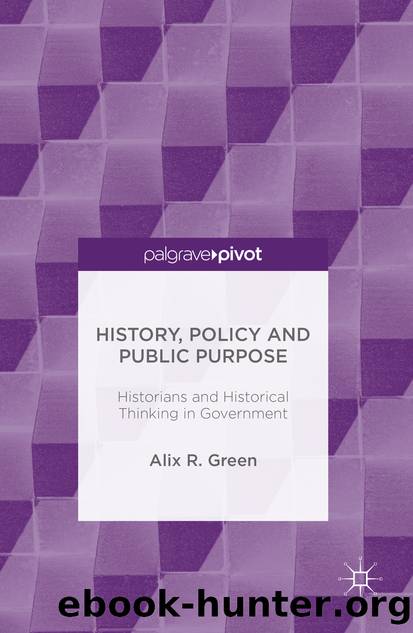
Author:Alix R. Green
Language: eng
Format: epub
Publisher: Palgrave Macmillan UK, London
Weaving Context
âContextâ is derived from the Latin, contextere, meaning to weave together. Weaving is an act of composition, in which threads are interlaced in a pattern to create the final woven product. From this original meaning we can grasp the importance of context to different disciplines. Context allows meaning-making; we âplaceâ or âlocateâ the individual thread or pattern within the fabric as a whole in order to interpret and understand it. Thus, context has an important explanatory function. Anthropologists, given credit for leading an intellectually substantial contextualist turn in the 1960s and 70s, take care not to isolate the text or the practice under observationâa ritual, musical form or narrative, for exampleâfrom the original site of production.16 In policy science, context is âa conceptual device to compensate for the lack of behavioral rules and methods to compare behavior across time, space, organizations, and functionsâ.17 More recently and more positively, attention has been given to the complex cultural practices embedded in policy contexts, a recognition that explanations of political activity are enriched by contextual understanding.18
For historians, the weaving of context is essential to the historical account. If our accounts are to be more than chronicles, we must rely on contextual analysis to interpret sources, assess their significance, identify continuity and change, make valid distinctions or comparisons and so on. Contextual analysis also serves to authenticate our accounts and we provide a guide to our intellectual labour in the scholarly apparatus. âContextâ is therefore much more than its usual synonyms, such as setting, environment, milieu and background, suggest.19 In terms of history in government, however, âcontextâ tends to be understood in these more limited senses: preface rather than policy. Articulating the power of contextual thinking for policymaking is therefore an important task.
The weaving of context involves asking questions that create connections between âpresent knowledgeâ and the âcircumstances of the pastâ. The process is a form of oscillation between past and present, which incrementally builds up a map or image representing the historianâs understanding of the past in the present. Questioning allows the historian to âget a fix onâ what is not known; once gaps are identified, a new focus for the enquiry is gained.20 The value of such skilled questioning to the collective puzzling of policy learning is clear. The historian on the inside can, of course, acquire âknowledge of historical specificsâ relevant to a task pursued in the mixed unit but such âcontentâ cannot substitute for contextual thinking.21
Historyâs ability to inspect assumptions critically is a recurring theme; here we can focus on how the weaving of context helps the policy team to understand the people and organisations on whose attitude or conduct an intervention may depend. Attention should be given not only to political allies and agencies involved as collaborating or delivery partners, but also, and perhaps more importantly, potential sceptics and adversaries, interest groups with a stake in the policy agenda and influential observers (such as the domestic media and international audiences). âPlacementâ would involve the historian reviewing âdiscernible items
Download
This site does not store any files on its server. We only index and link to content provided by other sites. Please contact the content providers to delete copyright contents if any and email us, we'll remove relevant links or contents immediately.
| Anthropology | Archaeology |
| Philosophy | Politics & Government |
| Social Sciences | Sociology |
| Women's Studies |
The Secret History by Donna Tartt(19443)
The Social Justice Warrior Handbook by Lisa De Pasquale(12286)
Thirteen Reasons Why by Jay Asher(9106)
This Is How You Lose Her by Junot Diaz(7044)
Weapons of Math Destruction by Cathy O'Neil(6455)
Zero to One by Peter Thiel(5930)
Beartown by Fredrik Backman(5915)
The Myth of the Strong Leader by Archie Brown(5619)
The Fire Next Time by James Baldwin(5573)
How Democracies Die by Steven Levitsky & Daniel Ziblatt(5318)
Promise Me, Dad by Joe Biden(5225)
Stone's Rules by Roger Stone(5181)
A Higher Loyalty: Truth, Lies, and Leadership by James Comey(5075)
100 Deadly Skills by Clint Emerson(5016)
Rise and Kill First by Ronen Bergman(4886)
Secrecy World by Jake Bernstein(4861)
The David Icke Guide to the Global Conspiracy (and how to end it) by David Icke(4837)
The Doomsday Machine by Daniel Ellsberg(4608)
The Farm by Tom Rob Smith(4591)
